Quick facts
- Thai name: พระครูสุนทรคุณธาดา (ทองกลึง สุนทโร)
- Temple: Wat Chedi Hoi, Bo Ngoen, Lat Lum Kaeo, Pathum Thani
- Born: B.E. 2485 (1942), Pathum Thani
- Ordained: 9 July B.E. 2512 (1969), Wat Chinwararam Worawihan, Pathum Thani
Lp Tongkern is the name I use for the abbot of Wat Chedi Hoi, the Temple of the Shell Chedi, in Lat Lum Kaeo, Pathum Thani. In Thai he is หลวงพ่อทองกลึง สุนทโร, with the ecclesiastical title พระครูสุนทรคุณธาดา. Romanisation is unsettled: Luang Phor Thong Klueng, Thongklueng, Thong Gleung, Tong Glerng, and similar forms all point to the same monk. The standard Thai is Thong Klueng (ทองกลึง).
Names and dates
A newspaper interview published in September B.E. 2562 (2019) gives his age then as 77, with 56 rains, which aligns with a birth in B.E. 2485 (1942) in Pathum Thani. Collector listings record the date as 12 April B.E. 2485, at tambon Bang Kradi, Mueang district. I have not seen a civil registration for the exact day, so I treat 12 April as reported rather than confirmed.
The same interview says he ordained at the age of 26, on 9 July B.E. 2512 (1969), at the uposatha of Wat Chinwararam Worawihan, tambon Bang Khayaeng, Mueang, Pathum Thani, after two years of military service. That is the date I follow here. Some amulet-dealer pages instead give an earlier ordination around B.E. 2505 (1962), and one listing that gives the 2485 birth also calls him 80 years old in B.E. 2561 (2018), which would not match. I have not used those figures.
Early life and teachers
In that 2019 interview he said he grew up in a farming family in Pathum Thani. When he was two years and four months old, cholera took his mother and two siblings. His father, unable to settle, was taken to stay with relatives, and later with an elder sister. Before his mother died she had wanted him to ordain. He did so at 26.
After about five rains, having passed Nak Tham Tho and paused before Nak Tham Ek, he went to Luang Phor Uttama of Wat Wang Wiwekaram, in Sangkhla Buri, Kanchanaburi. He stayed as a disciple for about six years, studying Dhamma, vipassana, tudong, wicha, and the Mon language. He later studied with Luang Phor Rod of Wat Krin, Pathum Thani (including the making of pirab rings and two-faced Somdej); with Luang Phor But at Wat Chinwararam, for holy water and the lifting of curses; at Wat Nam Wan with Phra Ajahn Klom and Phra Ajahn Ampha; with Luang Phor Seng of Wat Bang Na and Luang Phor Lee of Wat Song Phi Nong; with Luang Phor Salak of Wat Pradu Songtham, Ayutthaya; with Luang Pu Tian of Wat Bot, Pathum Thani; and with Luang Phor Thiam of Wat Kasatthirat, Ayutthaya. He then returned often to Luang Phor Uttama, and asked leave to go on solitary tudong: alone, without shoes, without accepting money from laypeople, and eating one meal a day.
A further period of tudong in Myanmar, and a vassa with Phra Ajahn Silabanta, is recorded in the temple’s published history and in the Thai cultural-register account of Wat Chedi Hoi. After returning to Thailand he stayed at Tham Ong Chuk, in Si Sawat, Kanchanaburi. There, according to that account, he had a nimitta of the present temple site as an ancient city called Rattanawadi, some eight million years ago, and followed the vision until he found the place. His father then bought the land and offered it for a monastic residence. I record this as the temple’s own founding story.
Wat Chedi Hoi
The first settlement was a small samnak, with a simple hut for laypeople who came to make merit. Wat Chedi Hoi was officially established on 20 December B.E. 2531 (1988). It is a village temple of the Maha Nikaya, at 73 Moo 4, Ban Khlong Bang Luang, tambon Bo Ngoen, amphoe Lat Lum Kaeo, Pathum Thani, on rural road PT 3020 (the Pathum Thani–Bang Len road). The grounds are recorded at 113 rai, 3 ngan and 8 square wa.
While a pond was being dug to water a herbal garden, workers uncovered a great quantity of ancient giant oyster shells. They were gathered over a long period — one account says the search lasted twelve years and ended in B.E. 2538 (1995) — and from that year they were built into chedi at the entrance and inside the grounds. The land here was once under the sea; the shells are traces of that earlier shore. The eight-million-year city of the nimitta is a matter of faith, not of confirmed archaeology. The finished shell chedi gave the temple its name: วัดเจดีย์หอย, the Temple of the Shell Chedi.
In the ubosot the principal Buddha image is Luang Phor Phra Phutthanimit Rattanachana Mar, more often called Luang Phor Chana Mar. The temple also keeps a museum of Buddha images, antiquities and old household things, including a large tridacna, or giant clam, shell brought from Ranong. Tourism pages sometimes call it the largest in the world; that is the temple’s claim, not a measurement I can verify. The temple is open daily, with no entrance fee. Published hours are usually 08:00 to 16:30, though some listings run to 17:00. It is most easily reached by car from Bangkok, via Lat Lum Kaeo.
He was still listed as abbot at a kathin in B.E. 2567 (2024). I have not independently confirmed the office after that year.
Amulets and objects
His better-known pieces, as they appear in collector and dealer records, include sacred-powder Somdej from earlier years — some with a yantra stamp on the reverse, and a Nak Prok type from around B.E. 2538 (1995) — and a Phra Sangkajai and Buddha-wheel powder piece from B.E. 2545 (2002). Close to the period of my visit, in B.E. 2551 (2008), there were recast ploughshare rian, called rian pan or lek thai na, made from old plough metal gathered and inscribed before melting. Some accounts of that 2008 consecration also name Luang Phor Chuen of Wat Nai Prap as present. These are the pieces I can document from published listings. I have not found a single official catalogue for every year, and I do not treat dealer dates as temple records.
A visit in 2009
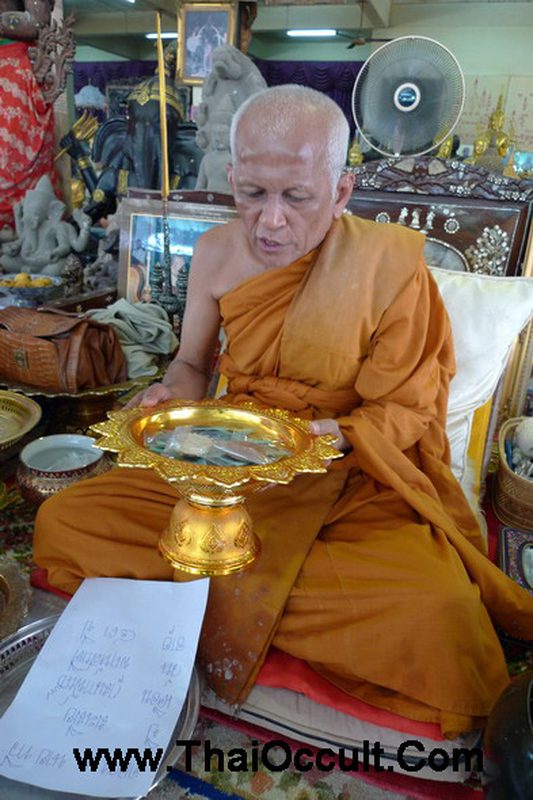
I visited Wat Chedi Hoi in 2009 (B.E. 2552), when his items were popular, to buy and sell pieces from the temple. The photograph here is from that day. There is no picture of the two of us in these files, and there is not yet an entry on Monks/Masters I Have Met. The Temple/Master Visits write-up is at Wat Chedi Hoi 2009.