Quick facts
- Thai name: หลวงปู่ทวด (also หลวงพ่อทวด; in the traditional account, ปู or ปู่)
- Temple: Wat Chang Hai (วัดช้างให้), Khuan Nori, Khok Pho, Pattani; also closely associated with Wat Phra Kho (วัดพะโคะ) in Songkhla
- Traditional dates: often given as born 3 March B.E. 2125 (1582) and died 6 March B.E. 2225 (1682), at about 100 years of age. These dates come from later traditional accounts; the evidence is not settled, and other years are also given.
- Period: Ayutthaya period, according to the traditional life; the modern amulet tradition begins much later, in B.E. 2497 (1954)
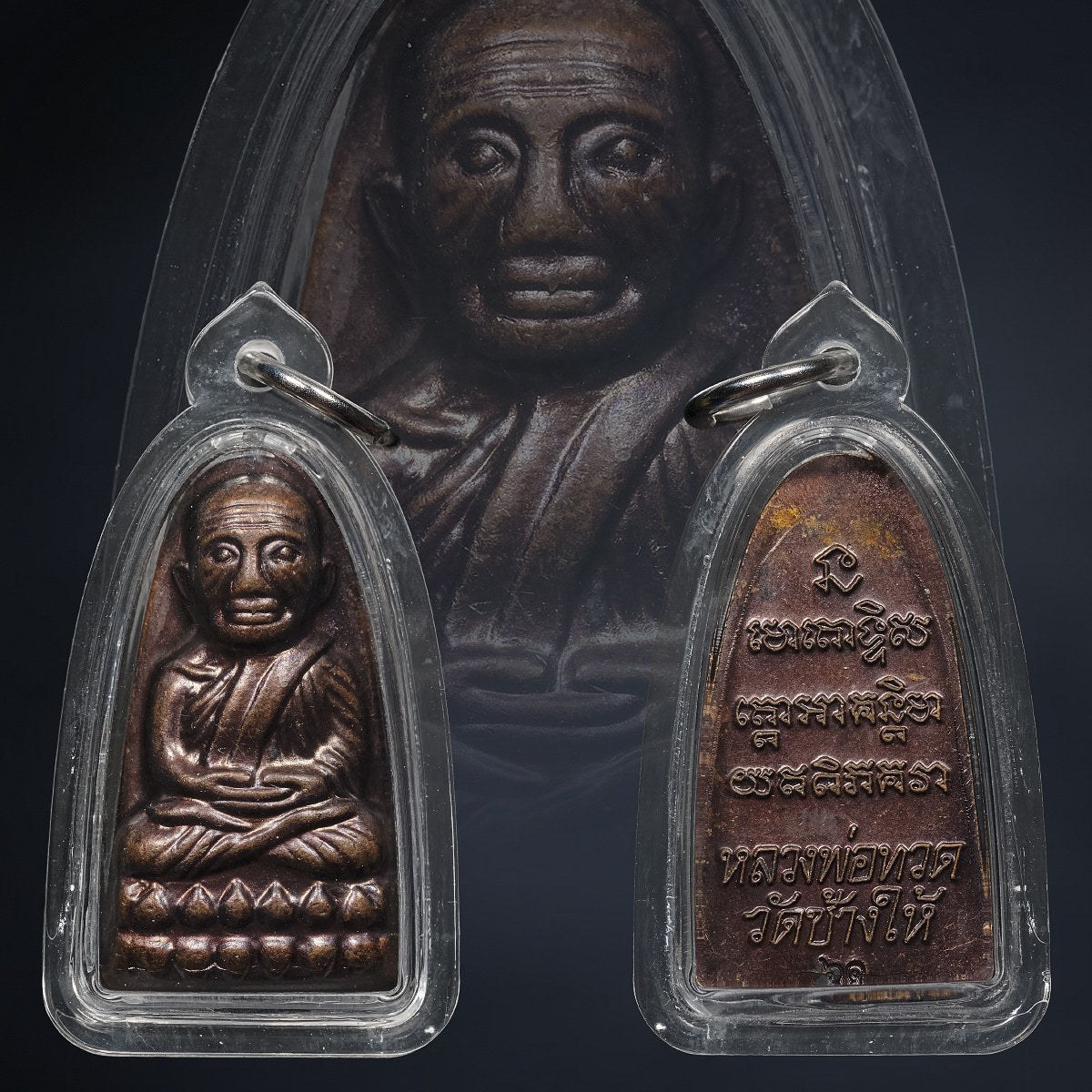
Luang Phor Tuad, or Luang Pu Thuat, is the legendary monk of Wat Chang Hai in Pattani — the one who, in the story that everyone knows, stepped on seawater and made it fresh. Amulets in his image are carried for safety, especially on the road, and for a protection that is trusted in moments of danger. The photograph here is not of me with the master. He belongs to a much earlier century. It is a Lang Nangsue amulet from the official Wat Chang Hai batch of B.E. 2561 (2018), used here as an image of him.
Names
In Thai he is หลวงปู่ทวด, also written หลวงพ่อทวด. Romanisation varies: Luang Pu Thuat, Luang Phor Tuad, Luang Pu Thuad, and similar forms all point to the same figure. On this site the katha page uses Luang Phor Tuad (Luang Pu Thuat); I use Lp Thuat in the same way I name other masters I deal with. Traditional accounts also call him Somdet Chao Phra Kho, and give a later ecclesiastical title, Somdet Chao Phraya Ratchamuni Sami Ramkhunupramachan (wording differs slightly from source to source). He is widely known as Luang Phor Tuad, the one who stepped on the sea and made the water fresh (หลวงพ่อทวดเหยียบน้ำทะเลจืด).
The traditional life
What follows is the traditional life as it is told, not a documented civil biography. The historical monk of the Ayutthaya period and the amulet tradition of the twentieth century are separated by roughly three centuries. Nearly everything that can be dated about the amulets belongs to the later period.
Traditional accounts say he was the son of Nai Hu and Nang Chan, debt-bondsmen in the household of a wealthy man named Pan, and that he was born at Ban Suan Chan (also called Ban Liab), in what is now Sathing Phra, Songkhla, during the reign of King Maha Thammaracha. His childhood name is given as Pu (ปู, “crab”); some texts write ปู่. The date most often repeated is 3 March B.E. 2125 (1582). Thai encyclopaedic notes themselves record that the evidence for the exact day and year is conflicting, and that other calculations have been offered, including a date in B.E. 2131 (1588). I treat 2125 as the usual traditional date, not as a confirmed register.
A well-known childhood story says that as an infant he was left in a cradle in the rice fields, and that a great snake coiled around him without harming him, then left behind a translucent gem. That gem is said to have remained with the family and later to have been kept at Wat Phra Kho in Songkhla. This is legend, repeated in local tradition.
The same accounts say he was sent to study at Wat Kudi Luang (Wat Di Luang) under Abbot Chuang at about the age of seven, became a novice at fifteen, and was ordained a monk at twenty. He is then described as studying further, including at Nakhon Si Thammarat and in Ayutthaya. The episode that defines his later reputation is the voyage: the ship was delayed in a storm, fresh water ran out, and he dipped his foot in the sea and made the water in that place fresh enough to drink. Versions of the story differ in the details — some speak of a voyage to Ayutthaya, some of pirates or a crossing — but the act itself is the image behind klaew klaad, the quality of coming through danger, especially in travel, that devotees attach to him above all others.
Tradition holds that in later life, around the age of eighty, he returned to reside at Wat Phra Kho, and that he asked his disciples, when he died, to take his body to the area of Khok Pho in Pattani, to Wat Chang Hai. The date usually given for his death is 6 March B.E. 2225 (1682), at Sai Buri, at the age of 100. One strand of the Pattani chronicle says part of the relics were returned to Sai Buri and part were buried at Wat Chang Hai. As with the birth date, I record this as the traditional account.
Wat Chang Hai
Wat Chang Hai (วัดช้างให้) stands in Khuan Nori, Khok Pho, Pattani. Official names vary: it is often recorded as Wat Ratsadon Burana (วัดราษฎร์บูรณะ), and some listings use Wat Chang Hai Rat Buranaram. Local tradition, as set down in the Pattani chronicle compiled by Phra Sri Buri Rat Phiphit (Sit Na Songkhla), traces the founding to Phraya Kaem Dam, lord of Sai Buri, who followed an elephant to an auspicious stretch of forest. The elephant is said to have circled the place and cried out three times. A temple was founded there instead of a new town, and called Wat Chang Hai — the temple the elephant had indicated. In that tradition Luang Pu Thuat was invited from Sai Buri as the first abbot. The temple is commonly described as more than three hundred years old. These are chronicle and temple traditions, not dates I can independently confirm.
The stupa of his relics stands on the grounds and is one of the main points of pilgrimage. After Ajahn Tim became abbot in B.E. 2484 (1941), he had that stupa built up so that people could come and pay respect. There is also a vihara of Somdet Luang Phor Tuad, with a principal image of him.
Ajahn Tim and the first amulets of B.E. 2497
The amulet tradition that people collect today does not come down from an object the historical Luang Pu Thuat is said to have touched. It begins at Wat Chang Hai in B.E. 2497 (1954), under Ajahn Tim Dhammatharo (พระครูวิสัยโสภณ, ทิม ธมฺมธโร).
Ajahn Tim was born Tim Phrompradu on 21 August B.E. 2455 (1912), in Na Pradu, Khok Pho, Pattani, the son of Inthong and Num, and the second of six children. He ordained on 7 June B.E. 2476 (1933) at Wat Na Pradu, with the chaya Dhammatharo; his preceptor is recorded as Phra Khru Phibun Somanawat. On 15 July B.E. 2484 (1941) he became abbot of Wat Chang Hai, during the years of the Second World War, with the title Phra Khru Wisai Sophon. These dates are much better attested than the Ayutthaya-period life.
In B.E. 2497 he worked with a patron, Anan Khananurak (อนันต์ คณานุรักษ์), to create the first Luang Pu Thuat amulets in herbal powder (nuea wan), to raise funds for the temple’s ubosot. Temple tradition holds that the form followed a vision of an aged monk seated in meditation on a lotus, with a dark-bodied image. Production is usually described as running from 19 March to 15 April B.E. 2497, from sixteen moulds, with about 64,000 pieces finished of a larger number first planned. The consecration is dated to 18 April B.E. 2497.
Accounts of who sat that first ceremony are not identical. Names that recur include Ajahn Nong of Wat Sai Khao (Phra Khru Thammakit Koson), Luang Phor Song of Wat Phra Kho, and Luang Pu Chin of Wat Muang Yala. Other reports add further southern masters. I record those names as they appear in the published accounts, and I do not treat any one list as complete.
Ajahn Tim continued to issue Luang Pu Thuat editions at Wat Chang Hai until his death. These include a first rian in B.E. 2500 (1957) and, in B.E. 2505 (1962), metal prints known as Lang Tao Reed and Lang Nangsue. Collectors often treat the years B.E. 2497 to 2512 as the Ajahn Tim period. He died on 30 November B.E. 2512 (1969), aged 57; a royal cremation was held on 14 August B.E. 2518 (1975). Official temple batches have continued after him.
The official batch of B.E. 2561
In B.E. 2561 (2018) Wat Chang Hai issued an official annual Lang Nangsue (book-back) print in mix alloy, a sitting Luang Pu Thuat, about 1.3 inches, in a plastic casing. I did not go to the temple myself that year. A close friend, who is also a collector, was riding through southern Thailand and, as he passed Pattani, obtained 250 pieces for me from that batch. I have written that journey up on the Temple/Master Visits page Wat Chang Hai 2018.
Kathas for Luang Phor Tuad are gathered at Luang Phor Tuad (Luang Pu Thuat).