Quick facts
- Temple: Wat Sanom Lao
- Province: Saraburi
- Born: 1 March B.E. 2456 (1913)
- Died: 15 October B.E. 2545 (2002)
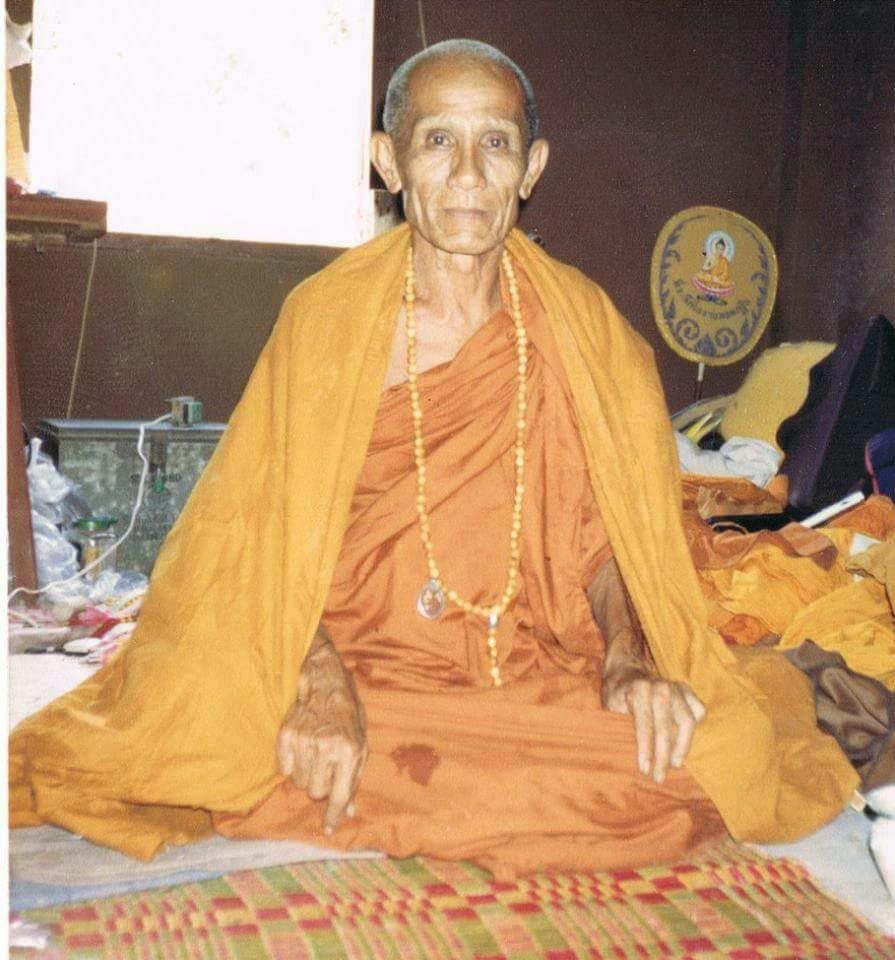
Among the Thammayut forest monks of the mid-twentieth century, later biographies place Luang Phor Phina Piyatharo in the circle of Luang Pu Mun Bhuridatto. He is the monk who took up the old ground at Wat Sanom Lao, in Nong Khae, Saraburi, and who left a written wish to remain seated there after death. The object most closely tied to his name is a star, read by collectors as a figure of the Buddhas of this kappa and of the arahants who guard the eight directions.
Names, Dates, and Place
Civil name: Thawai Hansarikit. The name Phina was given in childhood by Luang Phor Sin, abbot of Wat Nong Tao, Uthai Thani, after seizures that followed the boy’s crying; bios say the illness eased once the name was changed. The Dhamma name on his last will is Piyatharo. He was the eldest of five children of Thet, a soldier who also farmed and traded, and Tui, who traded. The siblings were Phina, Soemkiat, Surat, Sanguan and Sunthon.
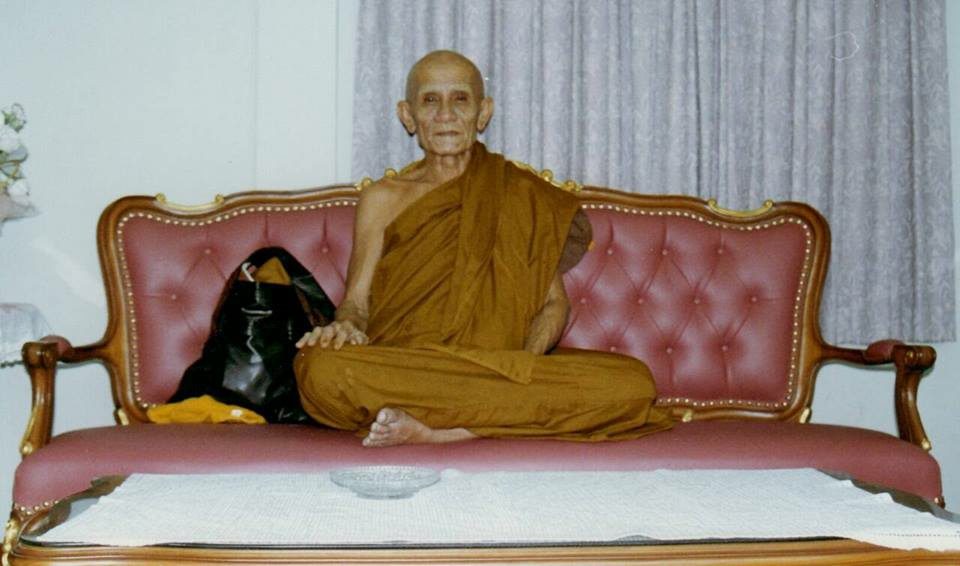
He was born on 1 March B.E. 2456 (1913), at Ban Hua Lamphong, Thap Than, Uthai Thani. He died on 15 October B.E. 2545 (2002), about 05:14, at Wat Sanom Lao, aged 89. The temple stands in Tambon Khok Yae, Amphoe Nong Khae, Saraburi, and belongs to the Thammayut nikaya. It is also written Wat Phra Sanomlao Wihan. Some biographies add the name Wat Thai Ngam. English listings often use LP Pinut or LP Pinak, and spell the temple Sanamlao.
Asubha Practice
After his father’s death he took novice robes, then full ordination in B.E. 2481 (1938) at Wat Nong Tao. The preceptor was Phra Khru Udom Khunaphon, then ecclesiastical head of Thap Than. The kammavacacariya was Phra Maha Amnuay. In the same year he passed Nak Tham Tri, the first grade of the Nak Tham exams. That grade is sometimes misread in English as a “third” level. It is the first.
He moved to Wat Ko Thep Thepho, Manorom, Chainat, to stay the rains with Luang Phor Kham. Kham taught him to look at the body as asubha — as something already subject to decay, not as a thing to dress and fear. Bios say fear of corpses had nearly ended his life in the robe, and that this teaching is what held him. He then kept two rains at Wat Tham Tako, in Tha Wung, Lopburi, a stay often dated B.E. 2482 to 2484 (1939 to 1941), after the master he had hoped to meet there had already died.
Tudong
From about B.E. 2485 (1942) the biographies send him out on a long tudong, through the north and south of Thailand, and, they say, through Burma, Laos, Cambodia and India. They then set him down as a disciple of Luang Pu Mun at Wat Pa Sutthawat, Sakon Nakhon, and they also name Luang Pu Fan Acharo and Luang Ta Maha Bua as teachers he practised with. This is the traditional lineage claim. It is not a dated entry in a monastery chronicle opened for this account. Luang Pu Mun himself died in B.E. 2492 (1949). What can be said with more safety is that later writing locates Phina in that forest circle, and that the wandering years run on until he settled in Saraburi.
The Old Ground at Sanom Lao
In B.E. 2527 (1984) he came to an abandoned Ayutthaya-period site at Ban Sanom Lao Khao Bot. The villagers asked him to remain. That site became Wat Sanom Lao. Official registration as a people’s temple of the Thammayut sect came only on 21 June B.E. 2553 (2010), after he had already died. He did not sign a royal ecclesiastical title. On his will he is Phra Phina Piyatharo, senior meditation teacher and president of the practice group of Wat Sanomlao Wihan.
Collectors also assign him an earlier workshop period at Wat Tha Koei, Phetchabun, before the Saraburi years, and date the first generation of his stars to that stay.
The Seated Burial
On 4 October B.E. 2545 (2002) he wrote what was to be done with his body. There was to be no embalming and no cremation. The body was to be kept seated, in a place he had already had prepared, called the Phina cemetery. There was to be no funeral chanting, and not many people were to be told. Eleven days later, on 15 October B.E. 2545 (2002), he died at the temple, about 05:14, still seated in meditation. Bios say the body stayed soft for more than twelve hours. On 16 October, Phra Phisan Mongkhon Wat, then Thammayut ecclesiastical head of Saraburi, had the remains placed in a glass coffin, seated, at that prepared site.
Disciples later covered the cemetery with a chedi about ten metres high, built in the manner of Phra Pathom Chedi, over a water basin. Club accounts later say he had also spoken of lightning striking the stupa after ten years, and that the remains were moved again after that event. A visitor in November B.E. 2560 (2017) recorded them then kept in a sala, still in the meditation posture, while the temple raised funds for a more permanent hall. The arrangement after that year has not been re-checked here.
The Star as a Dhamma Figure
The piece that carries his name into collector rooms is the Dao Atharn, also called Dao Mae Nuea Hom, and in English listings Dao Mae Nur Hom or Dao Mae Nam Hom. It is not a Buddha image in the ordinary sense. It is a star. One face is usually of five points, read as the five Buddhas of this Bhaddakappa. The other is of eight, read as the arahants of the eight directions. Collectors treat Mae Nuea Hom and Mae Nam Hom as related mixes rather than a single formula, and they say some early Mae Nuea Hom pieces were not worn on the same chain as ordinary phra.
Association contest lists periodize the work. The Wat Tha Koei era is given as about B.E. 2500 to 2520 (1957 to 1977): large and other early stars, the heavenly-eye type called Duang Ta Sawan, and printed phra such as Vinai and Paramat. A first medal is illustrated in B.E. 2498 (1955). The Sanom Lao era, B.E. 2527 to 2545 (1984 to 2002), continues the stars and the eye pieces, and adds paladkik, Rahu, Phra Sut, Somdej, and related types. These are collector ranges, not a set of consecration days. A first official posthumous batch from the temple side, Roon Sang Sala Chaturamuk, was blessed on 22 November B.E. 2561 (2018) by 108 monks, around the time a devotee club published a long illustrated biography of his objects.
Bios say he gave such things mainly to people close to him, and preferred to teach Dhamma rather than to hand out amulets. After B.E. 2545 (2002) the stars were sought far beyond that first circle, for metta, mahaniyom, fortune in trade, and protection.