
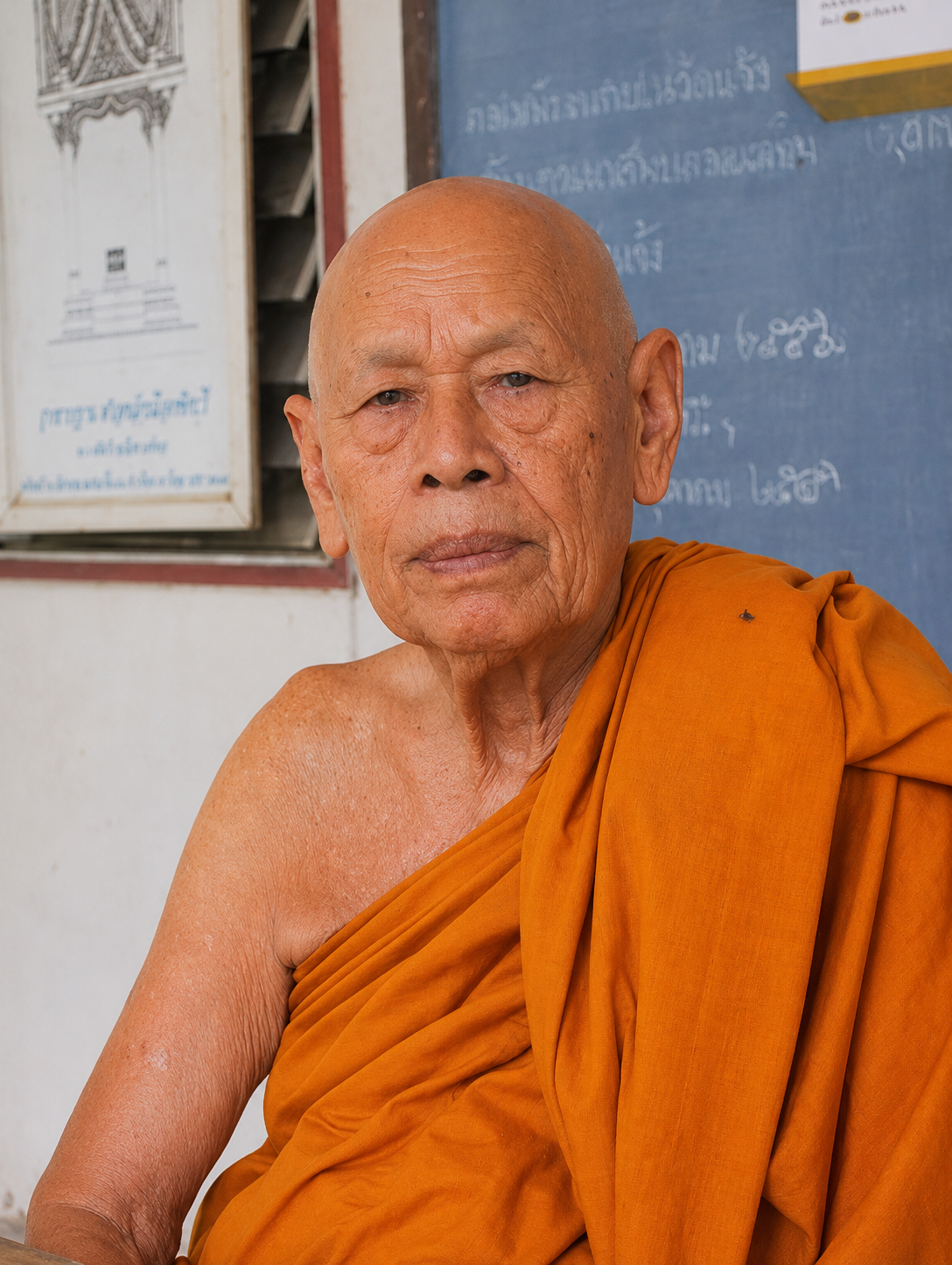
Quick facts
- Temple: Wat Jaeng
- Province: Phatthalung
- Born: Wednesday, 4 January B.E. 2475 (1932), at Ban Moo 3, Tambon Tonot Duan, Khuan Khanun, Phatthalung
Luang Phor Pong of Wat Jaeng, also known as Phor Than Phong Thanuttamo, is remembered as a respected Southern Thai master and as abbot of Wat Jaeng in Chai Buri, Mueang Phatthalung, Phatthalung Province. His ecclesiastical title is Phra Kru Sittikarnsophon. Devotees recall him for generosity, careful monastic discipline, and a long reputation for protection and metta.
Thai biographical accounts present him as a Supatipanno of Phatthalung: a monk whose public work in the province has been as widely noticed as the sacred objects associated with his name.
Early Life in Phatthalung
Newspaper biographies record his birth on Wednesday, 4 January B.E. 2475 (1932), at Ban Moo 3, Tambon Tonot Duan, in Khuan Khanun, Phatthalung. His father is named Huay and his mother Poon Aksornthong. Those accounts remember him as a bright and generous child, already inclined to help the people around him.
Ordination and Teachers
At the age of seventeen, on 4 January B.E. 2492 (1949), he was ordained as a novice at Wat Jaeng. His preceptor was Phra Athikan Sen Inthasaro of Wat Tha Miram, also known as Wat Intharawas. He received full ordination at the same temple on 3 January B.E. 2495 (1952), again with Phra Athikan Sen as preceptor, Phra Phinit Thammakon (Daeng) of Wat Pak Sa as kammavacacarya, and Phra Baidika Nu Pasanno of Wat Pak Sa as anusasaka. His monastic name is Thanuttamo.
After ordination he continued his study of southern wicha with Por Than Sen of Wat Tha Miram and with Por Than Ket, a senior Phatthalung master whom newspaper biographies associate with Wat Jaeng and whom a later account also links with Wat Nong To Fan. He studied Pali and Dhamma at Wat Kuhasawan in Phatthalung and later in Bangkok, completing Nak Tham and Parian Tham 4 in B.E. 2503 (1960). The same accounts record that he trained in kammatthana and vipassana with Luang Pu Toh of Wat Pradoo Chimplee. A later biographical page also places his work within the Khao Ao tradition of Phatthalung.
Wat Jaeng and the Community
Wat Jaeng is a Mahanikaya temple in Chai Buri, Mueang Phatthalung. Traditional temple records date its founding to B.E. 2381 (1838). Luang Phor Pong became its abbot and received the royal ecclesiastical title Phra Kru Sittikarnsophon. He has also been named as an advisor to the provincial sangha, and government ceremonies have honoured him with the task of carrying water from Khao Mueang for royal holy-water rites.
His public work in Phatthalung is remembered as widely as his sacred objects. Biographical accounts credit him with bridges, roads, schools, childcare centres and scholarships, with the restoration of the ancient chedi of Chai Buri, with the Phra Maha That chedi at Wat Ban Mai, and with ubosot building and the return of abandoned temples to active monastic life. For many devotees, this generosity is the heart of his baramee.
Blessings, Wicha and Sacred Objects
The objects associated with Luang Phor Pong are especially known for klaew klaad, protection, metta and good fortune. Among the better-known issues are the Metta Baramee and Charoenphon Maha Baramee groups, together with portrait roop muen, rian, pidta and carved wooden pieces made at the temple.
In B.E. 2556 (2013), Thai newspaper accounts reported that a young man in Phatthalung town came through a shooting with only bruises while wearing one of his amulets. After the report, devotees came to Wat Jaeng in large numbers, and the temple’s sacred objects became much more widely known.
That reputation sits alongside a quieter tradition of temple craft: wooden pieces carved and blessed at Wat Jaeng, including animals of protection and authority. For followers, the value of these objects lies in the master’s blessing, in the discipline of the temple, and in the long southern lineages from which his wicha was received.
The Legacy of Wat Jaeng
His legacy remains in the temples and public works associated with his name, in the affection of the disciples and devotees who honour his blessing, and in the sacred objects that carry the name of Wat Jaeng.
For those who collect or wear his pieces, the story is one of a southern abbot whose metta, protection and generosity have become part of the religious life of Phatthalung.
Shop authentic amulets at OOB Amulets.