Quick facts
- Temple: Wat Phra That Doi Kao Kwai
- Province: Chiang Rai
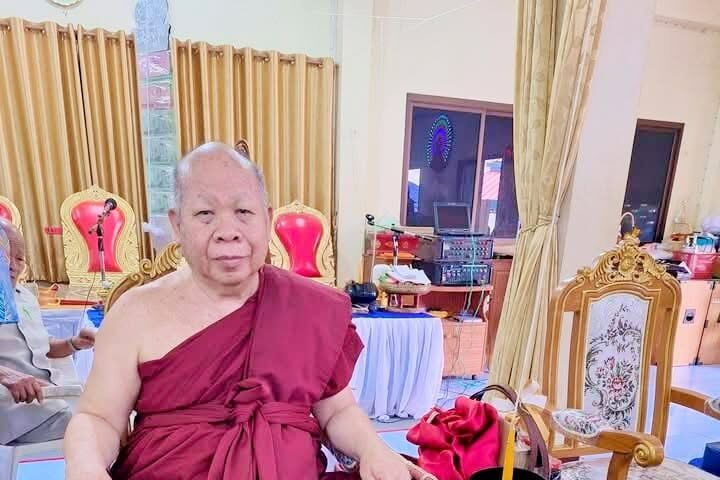
Devotees remember Kruba Sanong, also called Kruba Sanong Sumano, as a Northern Thai master and as abbot of Wat Phra That Doi Kao Kwai in Rob Wiang, Mueang Chiang Rai, Chiang Rai Province. Records also give him the ecclesiastical title Phra Khru Sumanachetiyarak. His name is tied most closely to the temple’s Si Hu Haa Taa tradition: a sacred being of four ears and five eyes, long linked in Lanna belief with livelihood, fortune and relief from hardship.
Published Thai sources say little about his childhood, birth or ordination. What they do record with clarity is his coming to the temple, his appointment as abbot, the restoration work he led, and the Si Hu Haa Taa tradition that has carried Wat Phra That Doi Kao Kwai’s name far beyond Chiang Rai.
Arrival at Wat Phra That Doi Kao Kwai
According to temple histories, he left Wat Chiang Yuen, also known as San Khong Luang, in B.E. 2519 (1976) and took up residence at Wat Phra That Doi Kao Kwai. On 1 March B.E. 2528 (1985), Phra Phutthiwongwiwat — abbot of Wat Phra Kaew and then head of Chiang Rai’s provincial sangha — appointed him abbot.
From that day, the same accounts credit him with a long programme of restoration: new kutis and salas, glass for the relic chedi, a multi-purpose sala and a hall honouring Phaya Mangrai, the temple’s first ubosot, a vihara beside the Si Hu Haa Taa cave, and further buildings that turned the hilltop wat into both a pilgrimage site and a working monastery.
A Hilltop Temple Near Chiang Rai City
Wat Phra That Doi Kao Kwai, also written as Wat Phra That Doi Khao Kwai or Wat Phra That Doi Khao Kwai Kaew, occupies a forested hill in Tambon Rob Wiang, about five kilometres from Chiang Rai city. Traditional accounts treat it as an ancient sacred place of the city, restored in the Chiang Saen period, again in the time of Phaya Mangrai in B.E. 1805 (1262), and in the modern era by Kruba Khamla Sangwaro, a disciple of Kruba Srivichai, between B.E. 2500 and 2514 (1957–1971). Kruba Sanong arrived a few years later and carried on the care of the temple.
The chedi is associated with a Buddha relic, and the temple holds an annual blessing of the relic on the full moon of the Lanna eighth month. For many visitors, however, the wat’s name is now inseparable from Si Hu Haa Taa.
Si Hu Haa Taa in Lanna Belief
Si Hu Haa Taa, also called Maeng Si Hu Haa Taa or Phaya Si Hu Haa Taa, is a sacred being of Lanna tradition. Temple and local accounts describe a gentle, bear-like form, short and rounded, with four ears, five eyes and a dark body covered in fur. In the legend it eats hot charcoal, and what it leaves behind becomes gold.
A Lanna folk story recalls Phra Indra looking down from the heavens on a poor farmer whose rice had failed during a drought. Taking the form of this unusual being, Phra Indra came into the fields. The farmer caught the creature and, seeing that it seemed to want warmth, lit a fire. He later found that the being had eaten the burning charcoal, and that gold had appeared by morning. The farmer’s fortune turned, and the tale became a local emblem of unexpected wealth, plenty and help in hard times.
The same tradition also finds a Buddhist reading in the form: the four ears stand for the four Brahmavihara, and the five eyes for the Five Precepts. When Chiang Rai hosted the 46th National Games in B.E. 2561 (2018), the province adopted the Si Hu Haa Taa of this temple as its mascot, Nong Kham Suk, and the legend became known across Thailand.
Amulet makers and temple notices often describe Wat Phra That Doi Kao Kwai as the original home of this tradition, and Kruba Sanong as the master who has blessed its modern sacred objects.
Sacred Objects of Kruba Sanong
The objects most closely tied to Kruba Sanong are the compact Si Hu Haa Taa figures known as Phra Indra Chamlaeng, the transformed form of Phra Indra. Better-known issues include the B.E. 2561 (2018) Bandan Chok Phokasap group, consecrated on 27 October 2561 in support of the temple ubosot, and the B.E. 2566 (2023) Luea Kin Luea Chai group. Devotees keep these pieces for fortune, livelihood, abundance, and the sense that help can arrive from unexpected directions.
For followers, the worth of these objects rests in the temple legend, in Kruba Sanong’s blessing, and in a Lanna tradition that joins wealth with kindness and moral life.
Legacy at Wat Phra That Doi Kao Kwai
His legacy remains in the restored buildings of the hilltop temple, in the Si Hu Haa Taa tradition this wat has carried into the wider country, and in the sacred objects that bear the name of Wat Phra That Doi Kao Kwai.
For those who collect or wear these pieces, the story is that of a Chiang Rai abbot whose blessing is joined to an old Lanna emblem of fortune, generosity and relief from hardship.
Shop authentic amulets at OOB Amulets.