
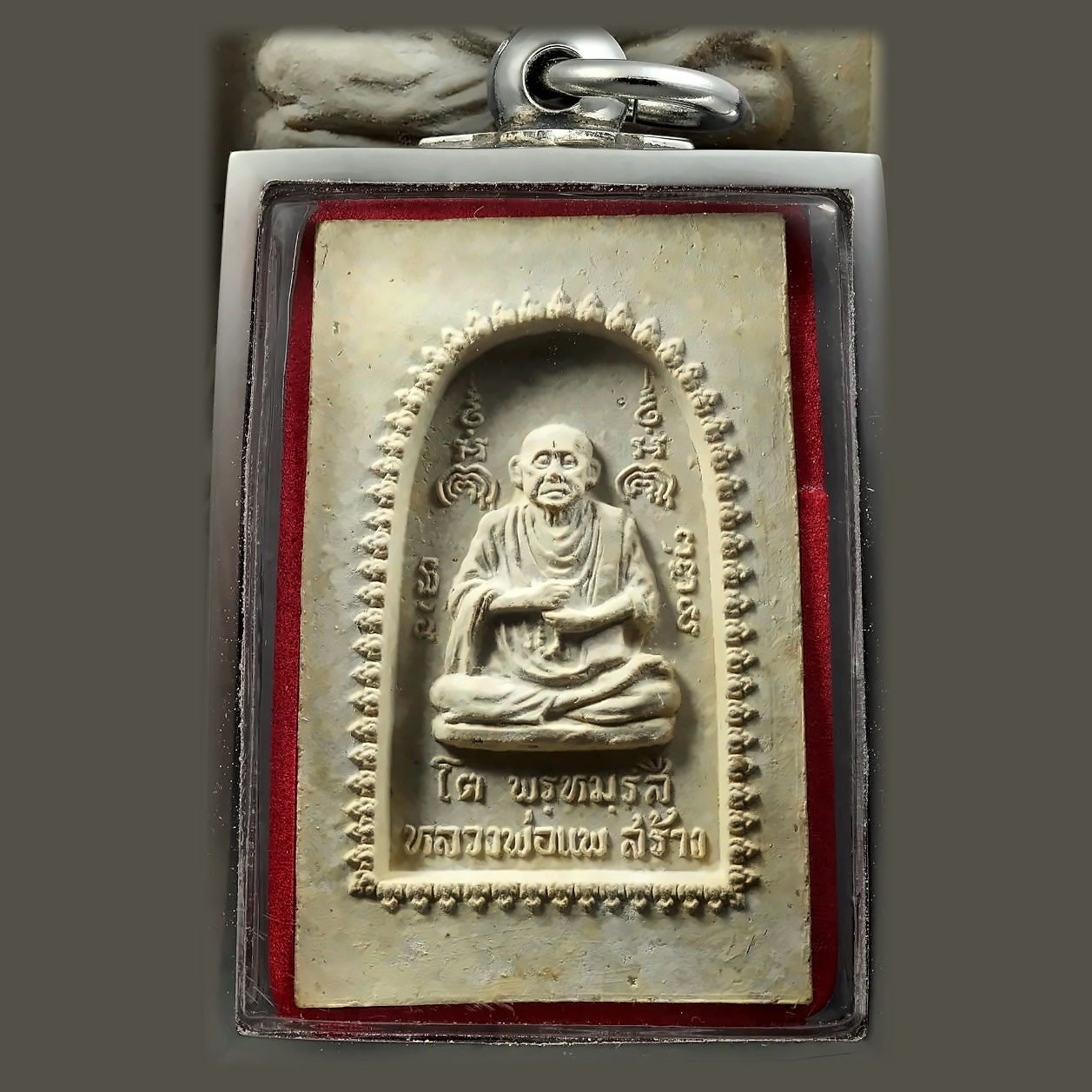
The Phra Kata Chinnabanchon, the Victor's Cage, is attributed to Somdej To of Wat Rakang, and it is used above all with Phra Somdej — though it is also widely recited over any Buddha amulet for protection. In these fifteen verses the reciter invites a host of Buddhas, disciples and protective suttas to take their places around the body, until the chanter dwells, as the poem says, in the cage of the Victor.
Thai text
Romanised
Short version
English meaning
The chanter invites the twenty-eight Buddhas who conquered Mara to dwell on the crown of the head: the Buddha upon the head, the Dhamma in the eyes, the Sangha in the chest. Great disciples — Anuruddha, Sariputta, Kondanna, Moggallana, Ananda, Rahula, Kassapa, Mahanama, Sobhita, Kumara-Kassapa, Punna, Angulimala, Upali, Nanda, Sivali, and eighty great elders — take their places at points around the body. Protective suttas, among them the Ratana, Metta, Dhajagga, Angulimala, Mora and Atanatiya, form a shelter in the air and a wall about the reciter.
The last verse gathers the blessing: by the power of the Victor, danger is overcome; by the power of the Dhamma, enemies; by the power of the Sangha, obstacles. Protected by the true Dhamma, the chanter dwells in the Victor's cage.
How to recite
Begin with Namo Tassa, recited three times. The Kata Bucha Phra Somdej may be offered next, then the fifteen verses of the Chinnabanchon. There is also a short form, recited ten times.
Two short versions are in circulation. One reads ชินะปัญชะระ สัพปุริวาณัง รักขะตุสัพพะทา. The other, which is the more grammatical of the two and the one generally recommended, is recited syllable by syllable: ชิ นะ ปัญ ชะ ระ ปะ ริ ตัง มัง รัก ขะ ตุ สัพ พะ ทา. Both are taken to mean, "May the Chinabanchon paritta protect me always."
Lineage
The great recitation is bound to the name of Somdej To and to Wat Rakang, and it has become one of the best-known protective chants in Thailand.
A note on the text
Some printings add the line เอตาสีติ มะหาเถรา ชิตะวันโต ชิโนระสา. A prefix beginning Puttakamo labhe puttang, often found in later books, is a later addition and is not part of the original fifteen verses. That prefix is given separately, under Kata Bucha Phra Somdej.
Two short forms are also in circulation, both recited ten times. They mean: “May the Chinabanchon paritta protect me always.” The second wording, with each syllable set out in full, is the more grammatical of the two.