
Thai text
Romanised
English meaning
The opening lines are plain in their meaning: "One who desires children shall obtain children; one who desires wealth shall obtain wealth."
The line that follows — "atthi kaye kayanyaya, thewanang piyatang sutawa" — has come down mainly by oral transmission, and is probably corrupted. A Thai chanting book of 1967 gives an older reading, adhikāraṃ labheyyāhaṃ devānaṃ piyataṃ sadā: "may I obtain merit, or greatness, and always be dear to the devas."
An extended version, added in many later printings, mixes Pali with Thai incantation and calls on Yama and Thao Wessuwan. It has no grammatical translation.
How to recite
Begin with Namo Tassa, recited three times, then this katha once. A familiar sequence continues with the Arathana Phra Somdej, one to three times, and then the Phra Kata Chinnabanchon.
Offerings are commonly:
- Three incense sticks
- Flowers and candles
For Somdej To, betel and a pair of bai sri are also mentioned.
Lineage
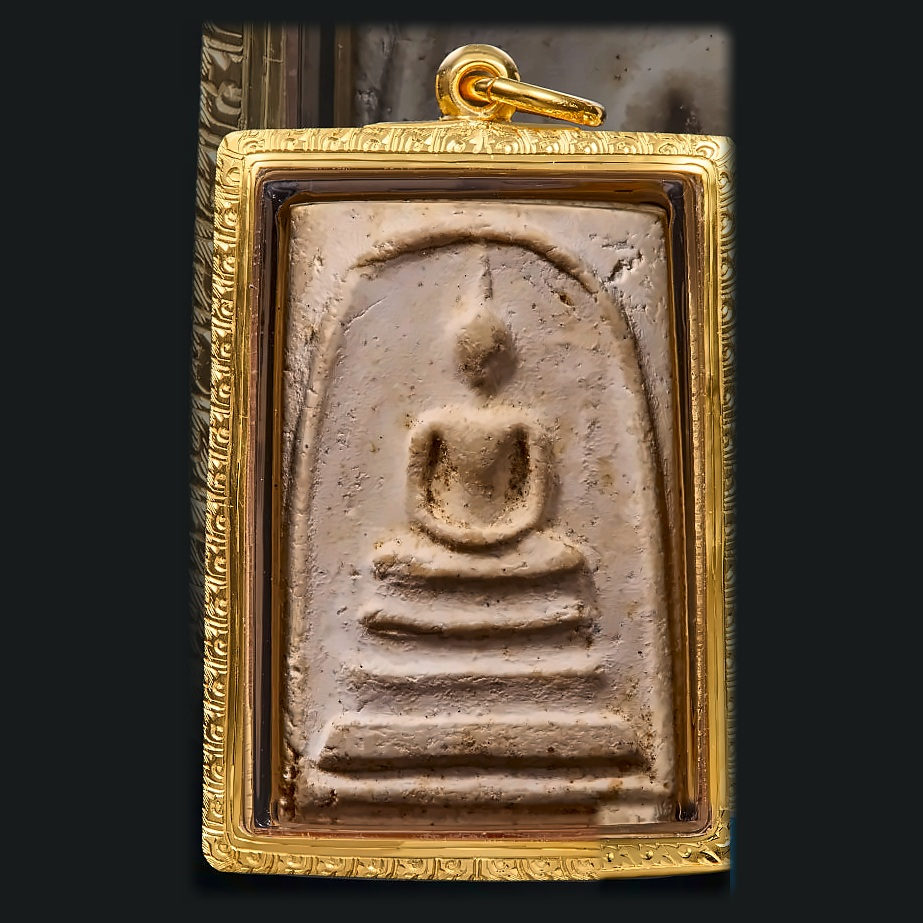
This recitation is popularly known as the Somdej To, or Phra Somdej, katha. A Pali scholar writing in the column บาลีวันละคำ has argued that the text is not part of the original Chinnabanchon, and is not in fact a homage to Somdej To — that it entered the tradition only in later printings. Even so, it remains the most widely printed Kata Bucha Phra Somdej, and it is in that form that it is given here.