Quick facts
- Temple: Wat Taa Ee
- Province: Buriram
- Born: B.E. 2461 (1918), at Ban Hin Kong, Svay Sisophon, Cambodia
- Died: B.E. 2547 (2004), at Wat Taa Ee
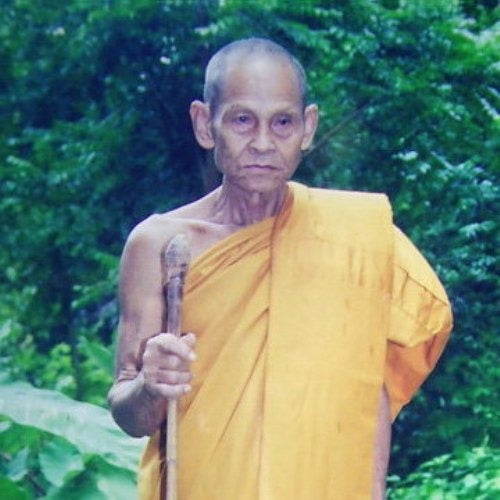
Luang Pu Chuen Tikkhayano, known to Singapore collectors as LP Chern, was a Cambodian-born forest monk who spent the last two decades of his life at Wat Taa Ee in Ban Kruat district, Buriram. Trained in the Khmer Wicha of Khao Kulen, he lived quietly for years before issuing his first amulets in B.E. 2542 (1999). Within a few years his Khun Paen — above all the Khun Paen Murumotoom — had made him one of the most sought-after Maha Seneh masters of southern Isan.
Early Life and Family
Disciple biographies record that he was born Chuen Srisot on a Friday in the eleventh lunar month of the Year of the Horse, B.E. 2461 (1918), at Ban Hin Kong in Svay Sisophon, Cambodia. His father was Chup and his mother Phim Srisot. He was one of seven children in a family of rice farmers.
He is remembered as a calm and generous child, drawn to the temple from an early age.
Ordination
At about fifteen, with his parents’ blessing, he became a novice at the temple of his home village. At twenty he received full ordination and the monastic name Tikkhayano.
Biographies note two early signs of his discipline. He learned to chant the full Patimokkha, the monastic code, within a single rains retreat, a task that can take other monks years. He passed the first level of Nak Tham, the Dhamma examinations, in his third rains.
Teachers and Lineage
After his studies he set out on tudong through the forests of Cambodia. Lineage accounts place him in the Khao Kulen line, the mountain north of Angkor long regarded as a centre of old Khmer sacred arts.
His first great teacher was Luang Pu Ueay, a monk famous in Cambodia, who is said to have passed on his methods and secrets in full. After Luang Pu Ueay passed away, LP Chern sought out Luang Pu Di Suwandi on Khao Kulen. With him he studied meditation, the Wicha of the four elements, and the making and consecration of sacred objects. Disciple accounts also tell of a forest hermit who taught him advanced Wicha.
LP Chern later told disciples that sacred arts only work when backed by a mind made strong through meditation. He was known for testing every method himself before he used it on amulets.
Tudong Years in Thailand
War and hardship in Cambodia scattered his family, and many relatives died. Weary of the turmoil, he crossed into Thailand as a wandering monk. Biographies record about five rains retreats at Wat Na Rak in Khon Buri district, Nakhon Ratchasima, before he took to the road again. As age caught up with him, he began to stay longer in one place.
Arrival at Wat Taa Ee
Around B.E. 2524 (1981) he was invited to a consecration ceremony in Buriram. Seated at the same meal was Luang Pu Nin Anuttaro, abbot of Wat Taa Ee. The two had been friends decades before and barely recognised each other. When they did, Luang Pu Nin invited him to spend the rains at Wat Taa Ee. The villagers asked him to stop wandering. He stayed for the rest of his life.
For years he lived in a small kuti like any elderly monk. He rose at three in the morning to chant, chanted again each evening, and few villagers knew of his training.
A well-known local story tells how that changed. Villagers kept bathing and washing clothes in the temple’s new drinking pond despite repeated requests to stop. LP Chern is said to have blessed two stones and thrown them in. Three days later, the story goes, two great serpents appeared in the water, and no one swam there again.
Sacred Objects and Notable Batches
In mid B.E. 2542 (1999) LP Chern released his first two or three batches of amulets. The temple needed funds for its ordination hall, and he said his teachers had told him the time had come to help people with what he had learned. Word of mouth did the rest.
Among pieces associated with LP Chern, collectors especially note:
- Khun Paen Murumotoom (Marum Matum): the name means to crowd around, the idea being that people and opportunities gather to the wearer. Collectors regard it as his signature piece. Recorded versions include plain sacred powder, Mai Wua Luem Khok wood, Sii Phueng wax and oil, with two to four embedded takrut. Two-takrut pieces are recorded with a male and female pair of silver or copper takrut. Few were made, and genuine early pieces rarely come to market.
- Khun Paen Sakot Thap: an early Khun Paen of about B.E. 2543 (2000), recorded as using the same powder as the Murumotoom and valued for protection and victory over rivals as well as charm.
- Other Khun Paen prints: including Khun Paen Sam Sao Mu Ban, Sam Athan, Khaen On, Nak Kiao and Phrai Kuman, many dated by collectors to B.E. 2543 to 2544 (2000 to 2001).
- First Rian, B.E. 2543 (2000): a blackened copper coin with yant on the back.
Devotees keep his pieces for Maha Seneh and Metta Mahaniyom, smoother trade and sales, good fortune and Klaew Klaad protection. These blessings reflect traditional belief and devotees’ experience rather than guaranteed results.
Passing and Legacy
LP Chern passed away at Wat Taa Ee in B.E. 2547 (2004), at about eighty-six. He is remembered alongside Luang Pu Rit of Wat Chonprathan and Luang Phor Say of Wat Nam Wichit as one of three Khmer-lineage masters who made southern Isan famous for Seneh amulets in that era.
His Wicha continued after him. Luang Phor Say, a long-time friend, issued Murumotoom pieces made in LP Chern’s tradition, and a lay disciple, Ajarn Sarayut, is recorded as donating LP Chern’s remaining sacred powders for them. Wat Taa Ee itself has since issued commemorative pieces using materials preserved from his lifetime.
For collectors, pieces made in his lifetime remain the true benchmark: the work of a quiet forest monk who waited most of his life before sharing what his teachers gave him.
Shop authentic amulets at OOB Amulets.