
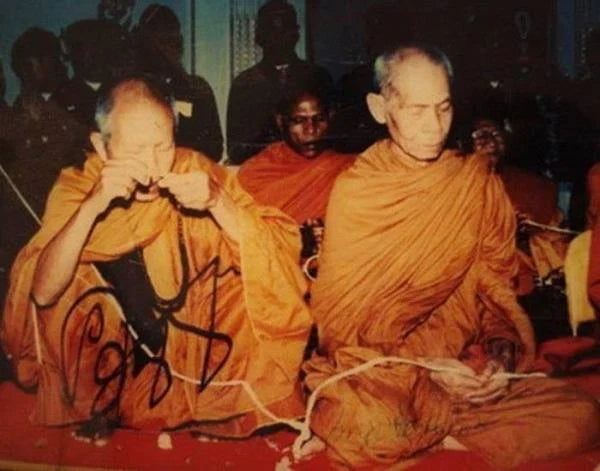
Quick facts
- Temple: Wat That Mahachai
- Province: Nakhon Phanom
- Born: 10 January 1915, in Na Kae District, Nakhon Phanom
- Died: Sunday, 24 November 2003, at Wat That Mahachai, aged 89
Widely known as Luang Pu Khamphan Khosapanyo (also written Kosapanyo), Phra Sunthonthammakorn was a revered Thai Buddhist monk, meditation master, teacher and developer of Buddhism in Nakhon Phanom and the wider Mekong region. By 2003 he was 89 years old and had completed 59 rains retreats in the monkhood. He was abbot of Wat That Mahachai, in Mahachai Subdistrict, Pla Pak District, Nakhon Phanom, and served as ecclesiastical head of Mahachai Subdistrict.
Early Life
Born Khamphan Srisuwong on 10 January 1915 in Moo 4, Na Kae Subdistrict, Na Kae District, Nakhon Phanom Province, he was the son of Ken Srisuwong and Lom Srisuwong.
At the age of 17, on 7 September 1932, he was ordained as a novice at Wat Sri Bun Rueang in Nong Hoi, Na Kae, with Phra Ajarn Chueam as his preceptor. In those years he studied traditional Dhamma script and ancient texts, and trained in meditation as well.
Meditation instruction later came from Luang Pu Sao Kantasilo, who taught him to establish mindfulness of the breath and to understand the Five Aggregates according to their true nature. Luang Pu Khamphan would later be associated with the forest-meditation lineage of Luang Pu Sao Kantasilo, Luang Pu Mun Bhuridatto and Luang Pu Fan Ajaro.

Above: Arjan Sao, teacher to Luang Pu Khamphan and fellow classmate and teacher of Ajahn Mun.
After three years as a novice, he set out on tudong pilgrimage to Loei Province with two monks. There he studied meditation for around three to four months with a white-robed ascetic named Khrut. He then returned to practise at a forest monastery near his home for about three years, until villagers invited him to reside at the village temple.
Ordination, Family Duty, and Return to the Monkhood
Full ordination as a monk followed in 1935, when he was 20, at Wat Phra Phutthabat Chom Thong, Nong Hoi Yai, Na Kae, Nakhon Phanom. Alongside meditation practice he studied Buddhist scriptures, and in 1936 he passed the Nak Tham Tri level of Dhamma studies.
His mother died in 1939, when he was 24. Because his two younger sisters were still very young, he disrobed in order to care for them.
He ordained again as a monk in 1945, at the age of 30. Three rains retreats were spent in forest monasteries while he continued his meditation practice, and he became a teacher of Buddhist studies at Wat Phra Phutthabat Chom Thong.
He passed Nak Tham Tho in 1945 and Nak Tham Ek in 1946. He also studied Dhamma and Khmer scripts and became highly proficient in reciting the Patimokkha.
Founding Wat That Mahachai
In 1952 (B.E. 2495), at the age of 37, Luang Pu led about five families from Nong Hoi Yai to found a new settlement at Non Mahachai. The village was named Ban Mahachai, and there he established Wat That Mahachai, also known as Wat Khosakaram.
He became abbot of Wat That Mahachai and ecclesiastical head of Mahachai Subdistrict in 1966. He was widely respected for bringing development and spiritual growth to the temple, to local monastic communities and to neighbouring areas.
Phra Phuttha Saksit

Above: The original Prah Phutthasaksit.
In 1957 Luang Pu chaired the creation of the community Buddha image known as Phra Phuttha Saksit. The polished golden Mara-Vijaya Buddha image measures 13 inches across the lap and 18 inches high, and it is now enshrined on the upper floor of Luang Pu’s residence.
The image was made to commemorate the 25th Buddhist Century. As a model, Luang Pu chose a revered ancient Buddha image at Wat Klang in Nakhon Phanom. Local tradition held that the original had come from a cave in Mahachai, Laos, and had been enshrined at Wat Klang for around 300 years.
Devotees offered brass, copper, money, gold and other gifts for the casting. According to the temple’s account, gold appeared at the Buddha’s face and chest after the casting, in keeping with Luang Pu’s prayer that it gather at the face and heart.
Meditation Teaching and Legacy
Luang Pu Khamphan was regarded as an important Vipassana meditation teacher. From 1986 onward, Wat Pa Mahachai became a centre for meditation training under his guidance. Monks from temples throughout Nakhon Phanom came to study and practise there, then carried what they had learned back to their own communities.
Through this work, Vipassana practice spread widely throughout Nakhon Phanom Province, and Wat Pa Mahachai came to be recognised as an important model for meditation practice in the area.
Mekong River Sand Tradition
Local oral tradition recounts that, during a period of conflict along the Mekong border, Thai soldiers and villagers came to Luang Pu Khamphan seeking blessings. He is said to have told them that he had nothing to offer except the teachings of the Buddha, then instructed them to collect sand from the middle of the Mekong River.
The sand was brought back for his blessing and given out among the visitors as a sacred protective token. The account says this tradition helped build his reputation for blessings and protective sacred objects. It is also said that when he later created Phra Kring amulets, blessed Mekong River sand was placed beneath the base of each image.
The Power of the Pathat Withat
Another distinctive part of Luang Pu Khamphan’s spiritual work was his rare ability to attract and collect relics known as Pathat Withat (ปฐาตวิถี)—mystical white stones believed to be gifts or blessings from Naga beings.
These relics are no ordinary stones. They are said to enhance baramee (prestige and spiritual power), attract wealth and luck, emit metta (loving-kindness), calming people and surroundings, and offer protection on par with what was granted to the Buddha by the Naga during his enlightenment under the Bodhi tree.
Devotees close to Luang Pu reported seeing these relics appear during meditations or retrieved from remote forest locations. Those who received them experienced unexpected turns in fortune, business growth, and even miraculous escapes from danger. It is said the stones “choose their owner” and stay with those who walk with sincerity.
Passing
Luang Pu Khamphan died of old age at his residence in Wat That Mahachai on Sunday, 24 November 2003. He was 89 years old and had spent 59 rains retreats in the monkhood. His passing brought deep sorrow to his many disciples and devotees throughout Thailand.
Shop authentic amulets at OOB Amulets.