Quick facts
- Temple: Wat Ban Rai
- Province: Nakhon Ratchasima
- Born: 4 October B.E. 2466 (1923)
- Died: 16 May B.E. 2558 (2015), at 11:45 a.m., at Maharat Nakhon Ratchasima Hospital
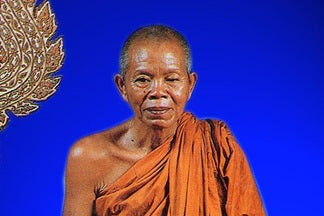
Luang Phor Koon Parisuttho, formally Phra Thep Witthayakhom, was one of the most widely revered monks of modern Thailand. From a poor farming family in rural Dan Khun Thot he rose to become abbot of Wat Ban Rai, a national figure of straightforward teaching, tireless charity and protective blessings. Devotees remember his squatting posture, the tap of his hand on a devotee’s head, his plainspoken Isan speech, and a lifetime of giving that built schools, hospitals and village works across the Northeast and beyond.
Early Life and Family
He was born Khun Chatphonkrang on Thursday, 4 October B.E. 2466 (1923), on the tenth waning day of the tenth lunar month in the Year of the Pig, at Ban Rai, Moo 6, Kut Phiman subdistrict, Dan Khun Thot district, Nakhon Ratchasima. His father was Bun Chatphonkrang and his mother Thongkhao Chatphonkrang, farmers in a remote and then little-developed corner of Korat.
Around the age of six or seven he studied Thai and Khmer script at the temple under Phra Ajarn Chueam Wiratho, Phra Ajarn Chai Kittipanyo and Phra Ajarn Li Arakkhayayo, successive abbots of Wat Ban Rai. They also taught him protective katha, so that from childhood he was already familiar with the sacred arts of the countryside.
Devotional biographies preserve a birth legend: before her pregnancy, his mother dreamed of a radiant deity who presented a clear jewel and foretold a child who would serve as a field of merit for the world.
As a teenager he worked the rice fields with relatives, rising before dawn and labouring until dark. The physical strain of farming, and a relative’s teasing that he should simply ordain if he could not endure it, helped turn his mind firmly towards the robes. He later recalled vowing that once ordained he would never disrobe.
Ordination
At twenty-one he received full ordination at the consecrated boundary of Wat Thanon Hak Yai, Kut Phiman, Dan Khun Thot, on Friday, 5 May B.E. 2487 (1944). His preceptor was Phra Khru Wichanyatikit, former ecclesiastical head of Dan Khun Thot. He received the monastic name Parisuttho, “the purified one.”
He later said that at first he meant to remain a monk for only three rains. Seeing the poverty of his home district, he resolved instead to dedicate his whole life to the Sangha and to the relief of his neighbours.
Teachers and Lineage
After ordination he trained under two important local masters: Luang Phor Daeng of Wat Ban Nong Pho and Luang Phor Khong Phutthasaro of Wat Thanon Hak Yai. The two teachers were close friends who exchanged Dhamma and sacred knowledge, and both shaped the young monk.
Luang Phor Daeng is remembered for samatha and vipassana and for deep ritual knowledge. Luang Phor Khong emphasised mindfulness, recollection of death (maranasati), and contemplation of birth, ageing, illness, death and personal responsibility for kamma. He taught that greed, hatred and delusion are the true enemies, to be met with sila, samadhi and panna. Khun also passed the elementary Nak Tham examination at Wat Thanon Hak Yai.
Tudong Years
When his teachers judged him ready, they urged him onto the tudong path. He wandered first within Nakhon Ratchasima, then farther afield. Biographical tradition describes barefoot travel through the Northeast to Phra That Phanom, into Laos, and on into Cambodia, with a return to Thailand through Surin.
His own rules for companions on tudong, as later remembered, were uncompromising: no riding in vehicles once the vow was made; no accepting money; no coaxing a friend to join against his will; and if death came on the road, cremation on the spot. He sought a mind trained in endurance and contentment, not display.
Building Wat Ban Rai
After returning home he set about turning a modest rural monastery into a lasting centre of Dhamma and public welfare. Around B.E. 2496 (1953) he led villagers into the forest to cut timber and haul it by ox cart and human labour over sandy tracks that could take days to cross. They raised an early ordination hall (later replaced), monks’ residences, a sermon hall, a water pond and, crucially, a school for the children of Ban Rai. His guiding thought, often quoted, was that a monk must not only receive alms from the village but also repay the village in kind: “If I do not do it, who will?”
Over the decades Wat Ban Rai grew into one of the best-known temples in Isan. The later Wihan Thep Witthayakhom complex stands as a monumental expression of the faith that gathered around him.
Character and Distinctive Habits
Luang Phor Koon’s manner was unmistakable. He commonly sat in a deep squat, a posture of village life that he kept into old age because he found it practical and familiar. He spoke in the Korat dialect with the blunt pronouns ku and mueng, which can sound rough in formal Thai but, among those close to him, carried intimacy and honesty. With elders he shifted to more formal address. He taught that wealth should be used to ease suffering, that generosity must be practised from childhood, and that people should abandon evil, do good, and keep sila in the heart.
Devotees came in great numbers to receive his blessing by the tapping of his hand on the head. He described the gesture as grounded in concentration and a solemn resolve, often naming protection from illness as he struck. He was also known for embedding gold takrut beneath the skin of the upper arm, with clear moral conditions such as never cursing one’s mother and never wronging another’s spouse.
Charity and Public Works
His fame as a geji was matched by an extraordinary record of dana. Temple donation ledgers beginning around B.E. 2513 (1970) record gifts ranging from small funeral offerings to multi-million-baht buildings. Named projects include hospitals in Dan Khun Thot, Bamnet Narong (Chaiyaphum) and Lam Sonthi (Lopburi), school buildings, bridges, roads, water works, police and district facilities, ambulances and medical equipment. Lifetime totals published after his death run into the billions of baht; the exact sum depends on which years and which projects are counted, but the scale of continuous giving is not in doubt.
He promoted vocational education so that local youths would not have to leave the district to learn a trade. Luang Pho Khun Parisuttho Technical College grew from a proposal dated 19 October B.E. 2536 (1993), with ministerial approval the following year and a royal opening in B.E. 2545 (2002).
On 11 January B.E. 2538 (1995), King Bhumibol Adulyadej and Queen Sirikit visited Wat Ban Rai to enshrine relics above the ordination hall. Luang Phor Koon presented 72 million baht for royal charity. His Majesty directed the funds towards relieving the district’s chronic water shortage, giving rise to the Huai Sam Bat tributary development works under the royal initiative.
Ecclesiastical Titles
In recognition of his service he received successive royal ecclesiastical ranks:
- B.E. 2535 (1992): Phra Yan Witthayakhom Thera (ordinary royal rank)
- B.E. 2539 (1996): Phra Ratcha Witthayakhom (Ratcha rank, Vipassana side)
- B.E. 2547 (2004): Phra Thep Witthayakhom (Thep rank, Vipassana side), the title by which he is formally remembered
Sacred Objects
Objects associated with Luang Phor Koon span many decades and many organisers. Among the landmarks collectors and devotees most often name:
- Early gold takrut (from about B.E. 2493 / 1950): among his first protective objects, often embedded in the upper arm, with strict moral vows attached.
- First portrait coin, the “Yon Sa” (Thrown into the Pond) issue of B.E. 2512 (1969): blackened copper coins released on 9 August 2512 for the consecration of a principal Buddha image at Wat Chaeng Nok, Nakhon Ratchasima, in a reported run of about 10,000. When demand outstripped supply and some accused him of favouring the rich, he is said to have thrown the remaining coins into the temple pond so that anyone willing could dive for them — hence the popular name. Many surviving pieces show surface wear consistent with that story.
- Sao Ha era of B.E. 2536 (1993): a peak period of national devotion, with many medals and images consecrated around highly auspicious Saturday-the-fifth timings. Sub-batches from this year are numerous; each needs its own organiser, mould, material and ceremony record. Some well-known 2536 medals were struck to high minting standards and blessed in long overnight sittings.
- Later commemorative and charity issues: coins and images produced for birthdays, hospital and school funds, royal occasions and the Wihan Thep Witthayakhom project, continuing into his final years.
Devotees seek his objects above all for metta and popularity, safety from danger, and steady fortune in livelihood, always alongside the moral teaching he insisted upon.
Later Years and Illness
From B.E. 2543 (2000) onward his health grew fragile. He underwent heart bypass surgery that year, brain surgery for a clot at Siriraj Hospital in B.E. 2547 (2004), and repeated treatment for infection, tuberculosis and other complications at Maharat Nakhon Ratchasima Hospital. In his last years a medical team cared for him at Wat Ban Rai in a controlled glass room, limiting visitors to protect him from infection.
Passing and Final Gift
He passed away at Maharat Nakhon Ratchasima Hospital at 11:45 a.m. on 16 May B.E. 2558 (2015), aged 92, with 71 rains. In keeping with his wish, his body was donated to the Faculty of Medicine at Khon Kaen University to serve as a great teacher for medical students. A royal cremation and commemorations followed after the anatomical teaching period, around B.E. 2562 (2019). Scholarships and memorials at Khon Kaen University continue that final dana.
Legacy
Luang Phor Koon remains for many Thai Buddhists the face of Isan metta: a monk who sat among villagers as one of them, spoke without ceremony, tapped a head in blessing, and poured the offerings of faith back into schools, hospitals, roads and water for the poor. Wat Ban Rai and the Wihan Thep Witthayakhom stand as the physical heart of that legacy. His amulets are held as reminders of a master whose power was never separated from generosity and moral restraint. In the words long associated with him: abandon evil, do good, and keep virtue in the heart.
Shop authentic amulets at OOB Amulets.