Quick facts
- Temple: Wat Bueng Phra Ajarn
- Province: Nakhon Nayok
- Born: around B.E. 2426 to 2427 (1883 to 1884), at Ban Chung, Phra Nakhon Si Ayutthaya
- Died: 15 July B.E. 2489 (1946)
Ajarn Fon Dee Sawang was one of the most celebrated white-robe lay masters of central Thailand in the first half of the twentieth century. Rooted in the countryside of Ayutthaya and later remembered across Lopburi, Nakhon Ratchasima and Nakhon Nayok, he is revered for overwhelming metta and popularity, kongkrapan and klaew klaad protection, healing of snake venom and illness, and the fierce blood-blessed yantra cloths known as pa sa lueat. Collectors and devotees still seek his portrait photographs, early medals and lineage lockets as living links to that old-school power.
Early Life and Family
He was born around B.E. 2426 to 2427 (1883 to 1884) at Ban Chung, Nakhon Luang district, Phra Nakhon Si Ayutthaya. His father was Sawang Dee Sawang of Ban Bo Phong, and his mother was Phaeng Dee Sawang of Ban Cha-om, both in Nakhon Luang. He was the third of seven siblings: Suwan, Fong, Fon, Fung, Mee, Liam and Lamduan.
While he was still young the family moved to Ban Pho Kao Ton in Lopburi. From childhood he was marked by a severe facial difference: he lost the bridge of his nose through illness, leaving a striking and often misunderstood appearance. Village children mocked him, yet those who later knew his wicha said that the same face became inseparable from an uncanny gift of metta — hostility turned to affection almost as soon as he applied the katha he had been taught.
Teachers and First Training
His parents placed him in the care of a maternal uncle who was abbot of Wat Klang in Nakhon Luang, remembered as Phra Ajarn Plod. That uncle was already famous locally for akom, herbal healing and a distinctive blood-linked sak yant practice. Because of his appearance, young Fon avoided ordinary classroom study with other boys and never became literate in the ordinary sense. What he possessed instead was an extraordinary memory. Taught a metta katha once or twice, he retained it completely and tested it at once on those who had rejected him; they became friendly. From then on he pursued sacred knowledge with tireless hunger.
Among the few childhood companions who stayed close was a boy later remembered as Samanera Tab, who would become Luang Phor Tab of Wat Makham Riang. When Fon later obtained sacred texts he could not read, it was this friend who recited them aloud so that Fon could memorise them.
Ordination and the Path of Wicha
In early adulthood he ordained as a monk, sources placing the early robes at Wat Klang or the village temple of Ban Chung. He stayed for a time at Wat Kai Fa in Bang Pahan, Ayutthaya, associated in tradition with Luang Phor Dee. Devotional biographies preserve the famous Nang Takhian episode from this period: as a newly ordained monk he intervened to stop villagers cutting a sacred takhian tree whose spirit had sought his help. In gratitude she offered him a choice of treasures; he chose the ancient books of katha and akom. Unable to read them himself, he had his monk-friend recite them until he knew every line. The texts included arts of stopping bleeding, drawing out snake poison, and many other protective and transformative arts.
He also trained deeply in healing and detoxification under his uncle’s medical akom line. Tradition says that after Phra Ajarn Plod passed away, Fon discovered further hidden manuals the uncle had kept back, and again mastered them through listening and practice. His memory and application were so rapid that he soon became known as a hot-wicha master — one whose powers pressed for expression.
From Monk to White-Robe Master
As his reputation for public displays of power grew — healing his own wounds before witnesses, calling and subduing cobras, transforming objects in ritual demonstration — senior monks reminded him that such showmanship sat poorly with the Vinaya. Understanding his own temperament, he disrobed and took up the white robes of a lay ajarn. From then on he practised openly as a householder master: covering disciples, blessing soldiers and traders, healing the sick, and travelling the central plains with a growing circle of followers.
Devotees of later generations often compared his metta to the legendary Khun Paen. The popular saying runs that where Khun Paen needed prepared offerings and a long ritual to win affection, Ajarn Fon needed only the gaze and the katha. That reputation for irresistible popularity, charm and social magnetism remains the core of how collectors describe his objects today.
Signature Ritual: Pa Sa Lueat
His most distinctive rite was pa sa lueat — the blood blessing. In the covering ceremony a disciple prepared white offerings (commonly nine white flowers, nine incense sticks, nine white candles, a white pha khao ma, a white cloth that became the phayant, and other traditional items). Ajarn Fon did not tattoo with ordinary needles. He cut yantra lines with the disciple’s own ritual knife, drew his own blood by cutting the tongue and driving blade-points into the palate, chanted over the blood, then spat or brushed it onto the white cloth and into the cut marks. The wounds on his own mouth were said to close after a further katha. The resulting blood-stained phayant became one of the most sought-after protective cloths of his era.
Later, because he could write only a few characters, stamped yantra cloths prepared with red ink mixed with his blood — notably pieces associated with his close disciple Ajarn Prayun Jitsophi — were also brought to him for a final pa sa lueat spit-blessing at major wai kru gatherings. Surviving cloths still show the blood marks that collectors look for.
War Blessings and Public Fame
Around B.E. 2480 (1937) he warned followers that war would come within three years. In B.E. 2483 (1940), during the Indochina conflict, the Thai court invited monks and sacred masters to prepare protective items for soldiers. Ajarn Fon was remembered as the rare white-robe lay master included in that summons. Because he did not write yantra in the ordinary way, he cut his mouth and applied his blood to white cloths for the troops. Tradition holds that soldiers who carried those blood phayant returned safely. He is also remembered for blessing Free Thai volunteers who resisted the Japanese occupation, marking them with yantra and herbal bathing for klaew klaad endurance.
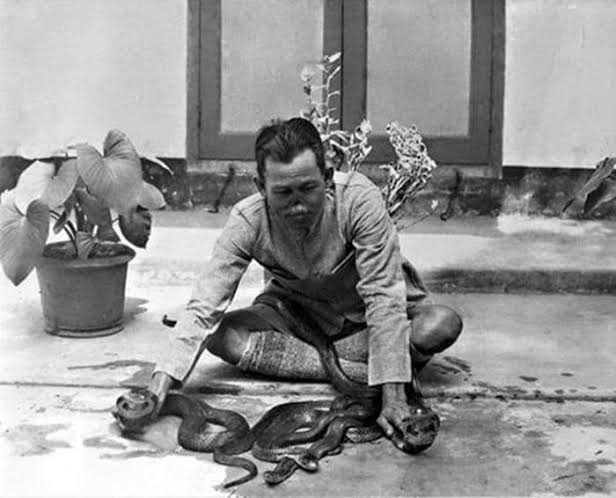
Between Ayutthaya, Lopburi and the Korat plateau his fame spread among traders, officials, likay performers and ordinary villagers. At Pak Chong railway station, when he travelled between Nakhon Ratchasima and Nakhon Nayok, crowds of disciples waited to see him on and off the train. He was equally known for calling cobras, binding their mouths, and sucking or drawing venom from bite wounds — arts he later passed to his leading students.
Later Years at Wat Bueng Phra Ajarn
In his final chapter he settled at Wat Bueng in Ongkharak, Nakhon Nayok, a monastery that came to be called Wat Bueng Phra Ajarn in his honour and was later renamed Wat Sunthon Phichitaram. There he continued healing, covering disciples and receiving devotees from Bangkok, Ayutthaya, Lopburi and Korat. The temple in the time of his foremost monastic disciple became almost a field hospital for snakebite and occult affliction cases from the surrounding countryside.
Passing
Ajarn Fon Dee Sawang passed away peacefully of heart disease on 15 July B.E. 2489 (1946), aged about sixty-two or sixty-three. His funeral drew officials, merchants and villagers from across the central region; a likay troupe whose leader was his disciple performed at the rites. His body was kept for a long period at Wat Bueng Phra Ajarn and was cremated only around B.E. 2537 to 2538 (1994 to 1995), nearly half a century later — a mark of how deeply the temple and lineage held him.
Principal Disciples and Living Lineage
Two names stand out among his foremost students:
- Phra Khru Methee Thammasathak (Luang Phor Noo / Luang Pho Nu), abbot of Wat Bueng Phra Ajarn, who carried forward the healing and snake-poison line until the temple itself was known for daily mercy to the afflicted.
- Ajarn Prayun Jitsophi of Nakhon Ratchasima, associated with the Jitsophi medicine house, who helped produce stamped blood-mixed yantra cloths for his teacher’s great wai kru.
A further generation includes Luang Phor Songa and, in the modern period, samnak masters such as Ajarn Tik of Ban Pong, Ratchaburi, who still issue Bucha Kru portrait lockets, coins and takrut under Ajarn Fon’s name, and other consecrators linked to Wat Bueng Phra Ajarn.
Sacred Objects
Objects tied to Ajarn Fon fall into several broad families:
- Original pa sa lueat phayant: white cloths marked with his blood, the classic signature pieces of the Indochina-war and late-career period, prized for klaew klaad, kongkrapan, metta and commerce.
- Portrait photographs and early lockets: vintage photo images of the master, often later encased; the form most familiar to modern devotees who keep his face close for metta and baramee.
- Brass portrait medal of B.E. 2490 (1947): widely called by collectors the first and only official struck medal associated with him. Because it is dated the year after his death, it is best understood as an early memorial or disciple-organised issue rather than a piece he personally supervised in life; authentic examples with Thaprachan or similar papers are scarce.
- Lineage commemorative lockets and medals: later batches by disciples and grand-disciples — for example lockets by Ajarn Aod of Wat Boonrod (B.E. 2557 / 2014), copper first-batch rian by Ajarn Thond of Wat Bueng Phra Ajarn (B.E. 2555 / 2012), and ongoing Bucha Kru editions from Ajarn Tik Ban Pong (including B.E. 2564 / 2021 and later), often filled with powders, takrut, or small wan phen coins of the master.
Devotees approach these objects above all for metta maha niyom and social magnetism, safety from danger and weapons, steady fortune in trade, and the healing, protective baramee of a master who gave his own blood for those under his care.
Legacy
Ajarn Fon Dee Sawang remains the archetype of the Ayutthaya white-robe wonder-worker: a man whom ordinary schooling passed by, yet who memorised entire manuals by ear; whose face the world mocked, yet whose metta was said to outshine even the legends of Khun Paen; who left the robes so that his hot wicha could serve soldiers, traders and the bitten poor without restraint. Wat Bueng Phra Ajarn in Nakhon Nayok still anchors his memory, and every blood mark on an old phayant, every stern portrait in a gold frame, continues the same invitation — to walk with the baramee of a master who held nothing back.
Shop authentic amulets at OOB Amulets.