
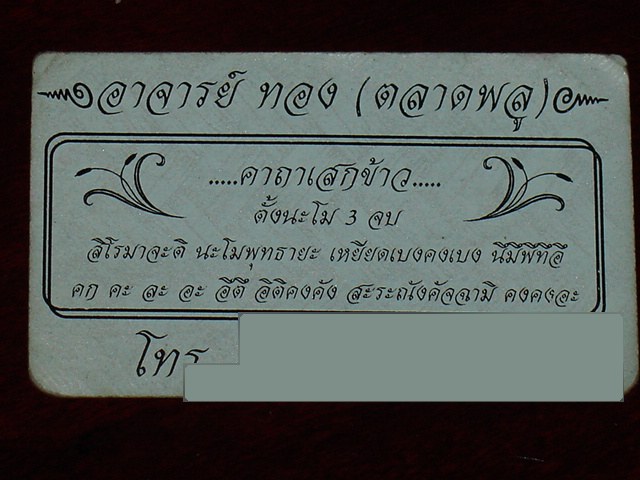
Thai text
Romanised
English meaning
No word-by-word translation is given on the card. The title names it as a katha for blessing rice — คาถาเสกข้าว. Within the recitation, นะโมพุทธายะ is homage to the Buddha, and สะระณังคัจฉามิ is the formula of going for refuge. The repeated คง, คงคัง and คงคง belong to the language of kong — invulnerability — as it is used in this tradition.
How to recite
The card instructs the reciter to begin with Tong No Mo 3 Jub:
Namo Tasa Pakawato Araharto Sama Sam Put Tasa X 3
and then to chant the katha:
อิโรมาจะติ นะโมพุทธายะ เหยียดเบงคงเบง นิมิพทิอิ
คก คะ ละ อะ อิติ อิติคงคัง สะระณังคัจฉามิ คงคงอะ
The card does not say how many rounds of the katha itself should be recited.
Lineage
This katha belongs to Ajarn Tong Sonthirot (อาจารย์ทอง สนธิรอด), known as Ac Tong of Talad Phu — อาจารย์ทอง ตลาดพลู, and sometimes as Por Tong Talad Phu. He was a lay sak yant master of the Thonburi side of Bangkok, remembered under the name of the Talad Phu neighbourhood.
He was born in B.E. 2494 (1951) in Sena, Phra Nakhon Si Ayutthaya. When he came of age he ordained at Wat Phleng, later left the monkhood, and returned to lay life, giving himself fully to sak yant, sacred letters, and katha. Accounts of his studies commonly name Ajarn Ha of Wat Yai Si Suphan, and Ajarn Tiang Nuammana (อาจารย์เที่ยง น่วมมานา) of Wat Thong — Wat Suwannaram — in Bangkok Noi. Ajarn Tiang is remembered as a lay master of Thonburi, himself in a line that includes Luang Pu Tong of Wat Rachayotha.
In B.E. 2520 (1977) he opened his house to tattoo in earnest, as the number of students grew. He was widely respected among Thai and foreign devotees for sak yant, and also for consecrated images and takrut. He passed away on 9 May B.E. 2557 (2014).
The recitation on this page follows an old name card of his. He appears in my Personal Journey section, in photographs from his Wai Kru ceremony at Fo Guang Hang in Singapore in 2009.