
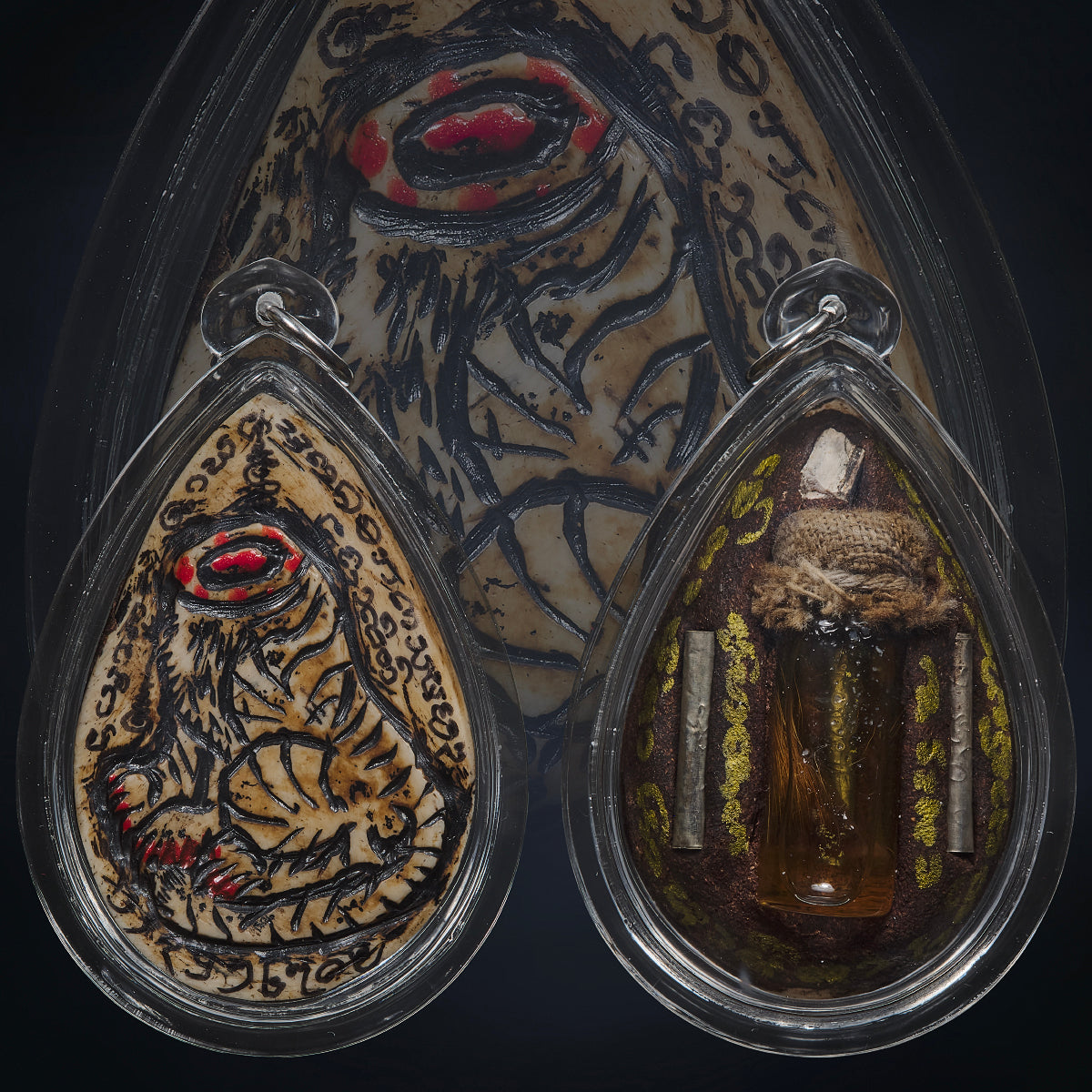
Among older Thai underworld circles, wandering fighters, gamblers, nak leng, and occult practitioners, the Headless Tiger sacred tattoo is a lesser-known but deeply feared tiger yantra. It is unlike the more familiar twin tigers or leaping tiger designs tied to authority and charisma. Suea Hua Khad carries a darker symbolism: raw survival instinct, fearless aggression, spiritual invulnerability, and the capacity to endure violent confrontation.
A Tiger Without a Head
Oral accounts handed down among older tattoo masters say the original Headless Tiger had no chains or restraints. The missing head stood for a state beyond fear, hesitation, and ordinary human emotion. In the old mystical reading, once the “mind” is taken away, only instinct and unstoppable force remain. Wearers were believed to become unusually daring, hard to intimidate, and highly resistant in conflict, which is why the yantra was feared.
In Chonburi decades ago, the tattoo’s reputation grew after several violent criminals arrested by the authorities were said to carry the same Headless Tiger design. Old accounts claimed these men were extremely difficult to subdue and seemed unusually resistant to weapons and fear. The original lineage then became controversial, and the master who transmitted the design was pressured to stop tattooing it openly.
The Restraining Pillar and Chain
A later change proved decisive: the addition of a restraining pillar and chain, which recast the meaning entirely. The image no longer stood for uncontrolled violence. The chained tiger meant power under discipline, expressed as: “I do not attack first, but if threatened, the tiger will respond.” Many practitioners later treated the chained Headless Tiger as a protective yantra rather than a destructive one. The tiger stayed powerful, but its force was anchored and controlled.
Tiger Yantras in Thai Sak Yant
The tiger has long held an important place in Thai sak yant. Across older Central Thai, Khmer, and Northern Thai magical systems, tiger yantras were linked to amnaj (authority), courage, intimidation, protection from enemies, battlefield survival, leadership presence, and commanding respect. Older businessmen, transport operators, underground figures, security personnel, and Muay Thai fighters often sought tiger tattoos, believing the energy projected confidence and made others hesitate before a challenge.
Northern Thai masters still work with tiger-based wiccha in many forms. Among collectors and practitioners in recent times, Por Sala Tan, Ac Bed, Por Tan Suksabai, and Arjan Tanakorn are all known to have used tiger-related yantras, takruts, or protective wiccha connected to authority, protection, and spiritual force. Each lineage expresses the tiger differently. Some emphasise metta and leadership; others emphasise kongkrapan, protection, battlefield mentality, or territorial authority. In Northern Thailand especially, tiger energy is often read less as simple aggression and more as “controlled dominance” — the ability to hold one’s ground spiritually, mentally, and socially.
Many older masters did not treat the tiger as merely an animal spirit. They saw it as a manifestation of an inner state of mind. A person carrying strong tiger energy was expected to become calmer under pressure, harder to manipulate, sharper in danger, and more decisive in life. Older practitioners often held that when someone lacked internal courage or baramee, even strong protective yantras would not activate fully.
Tiger Wiccha in Modern Life
People today are often drawn to tiger yantras for protection, career confidence, business negotiations, leadership presence, and overcoming intimidation in competitive settings. Many wearers describe feeling mentally firmer, more focused, and less easily shaken in periods of stress or conflict. Experienced practitioners rarely treat tiger wiccha as decoration. It is regarded as a discipline bound to conduct, mindset, courage, and personal control.
Study of older sak yant traditions makes it clearer that many of these designs were never made for aesthetics alone. They were survival systems carried by people living difficult lives — forest wanderers, fighters, traders, transporters, gamblers, and men constantly exposed to danger. The Headless Tiger became one of the most feared expressions of that older mentality because it represented force stripped of fear, and later, force restrained through discipline and spiritual control.
Shop authentic amulets at OOB Amulets.
Leave a Reply