Thai text
Romanised
English meaning
No word-by-word translation of these lines is given. They are the heart syllables of the Mae Nang Pim recitation as used in the lineage of Luang Phor Up of Wat Tong Sai.
How to recite
Pay homage to Buddha by chanting
Namo Tasa Pakawato Araharto Sama Sam Put Tasa X 3
Uu Ga Pa Sa Ha Na Put X 9
Make ur wish to Mae Nang Pim in precise detail e.g. Finding the ideal location or meeting the right real estate agent for the job etc
Lineage
This katha belongs to Luang Phor Up of Wat Tong Sai, the master most closely associated with Mae Nang Pim. In Thai he is commonly known as หลวงปู่อั๊บ, and by his monastic name Phra Athikan Kasem Khemajaro (พระอธิการเกษม เขมจาโร). The temple stands in Laem Bua, Nakhon Chai Si, Nakhon Pathom; its Thai name is วัดท้องไทร, and English spellings vary, including Wat Tong Sai and Wat Thong Sai.
Accounts of his life usually place his birth in B.E. 2465 (1922). He is recorded as having ordained at Wat Thung Noi, with Luang Phor Ma as his preceptor, and as becoming abbot of Wat Tong Sai in B.E. 2513. He passed away in B.E. 2555 (2012).
Mae Nang Pim is also called Mae Pim, Mae Pimpa, นางพิม and แม่พิมพา. Lineage accounts say that Luang Phor Up encountered this wicha during travels in Cambodia around B.E. 2535–2537 and brought it back to Wat Tong Sai, at first calling it Ee Due (อีดื้อ). From about B.E. 2537–2539 he began giving the associated yant to close disciples. Around B.E. 2540 the name Mae Pimpa came into wider use, as takrut and other forms were prepared so that devotees could keep the recitation without taking the tattoo. The first officially authorised powder edition, the Mae Nang Pim Roon Raek, is associated with B.E. 2546 at the temple.
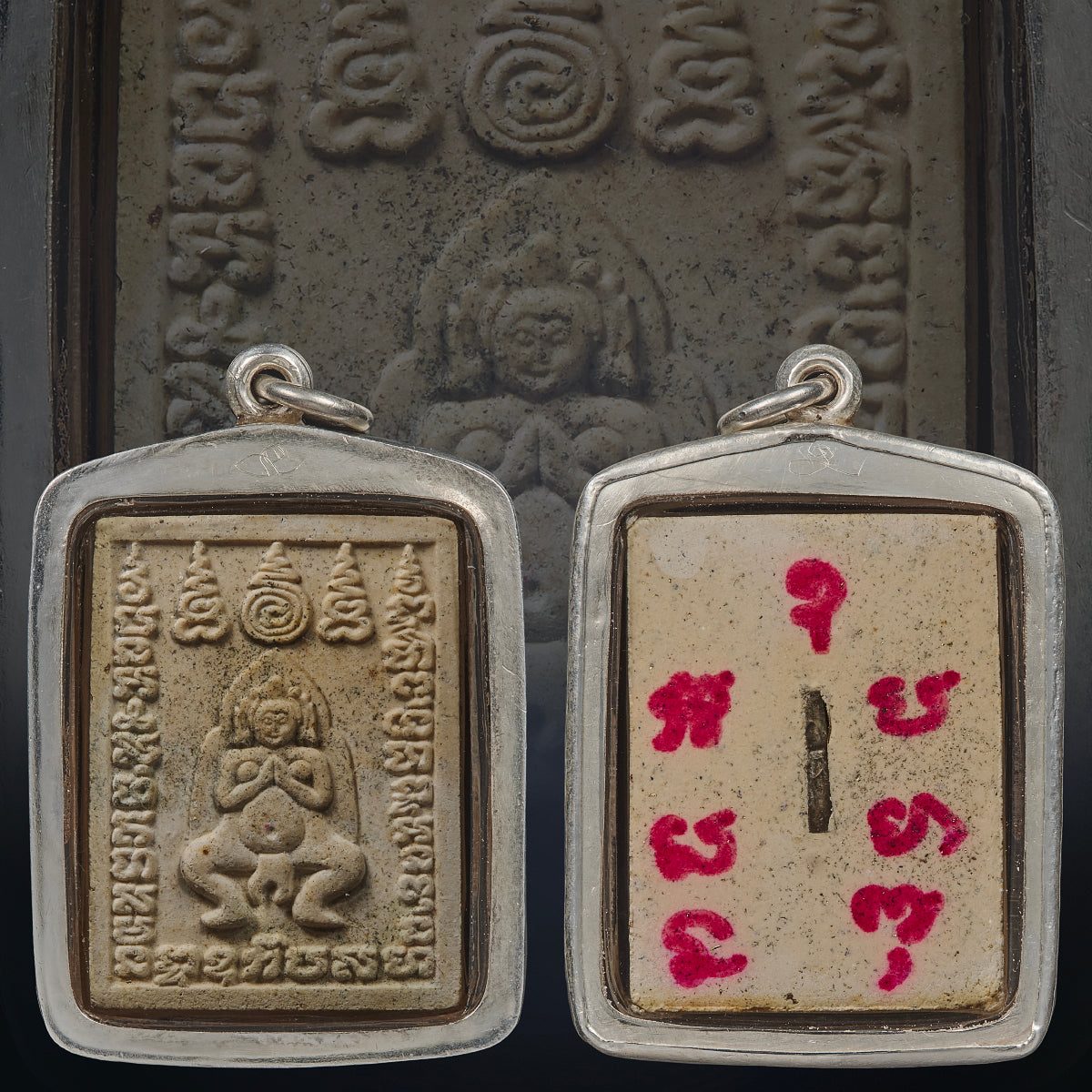
The image typically shows a pregnant woman, often crowned, with her hands raised in prayer, and sometimes with a child emerging. In this lineage she is venerated as a compassionate feminine deva — a mother figure asked for protection, goodwill, and the granting of wishes — and is not regarded as a prai spirit. A large image of Mae Pimpa is kept at Wat Tong Sai for devotees to approach. When a wish is fulfilled, accounts of temple practice often mention a thanksgiving offering of rice whisky, though the recitation given here is complete in itself: homage, the katha, and a wish stated clearly.